

Data orchestration platform on a governed data fabric
L1nks connects each of your systems once, catalogues what every one of them holds, and validates every record while it moves. It is what the market calls iPaaS, built by Elev8 and in daily use.
What is L1nks
What is L1nks?
L1nks is an enterprise integration platform: the hub every system connects to once, so that data moves between them through one governed layer instead of a web of direct links. The market calls the category iPaaS. We call it a data fabric, because the platform does not only move data, it knows what each system holds and what a correct record looks like.
Integration sprawl builds up one project at a time. Each new system is wired to the ones already there, and the arithmetic is unforgiving: connecting systems directly means every pair needs its own link, so 65 applications need 2,080 of them. CRM, billing, security, ITSM, monitoring, OSS: each one generates more.
With a hub, every system connects once and never to another system. The count then grows one at a time, so the sixtieth system costs what the tenth did.
Capabilities
What L1nks does between your systems
Discover
Every field and data shape discovered from the API
Import a system’s OpenAPI specification and L1nks picks up its endpoints, fields and data shapes. Where there is no specification, it reads the API’s standard documentation, online or as a file, and generates a connector from it using AI. Most organisations cannot produce an accurate inventory of what holds what. At the end of discovery you have one, and it was not typed by hand.
Catalogue
A catalogue of what each system holds
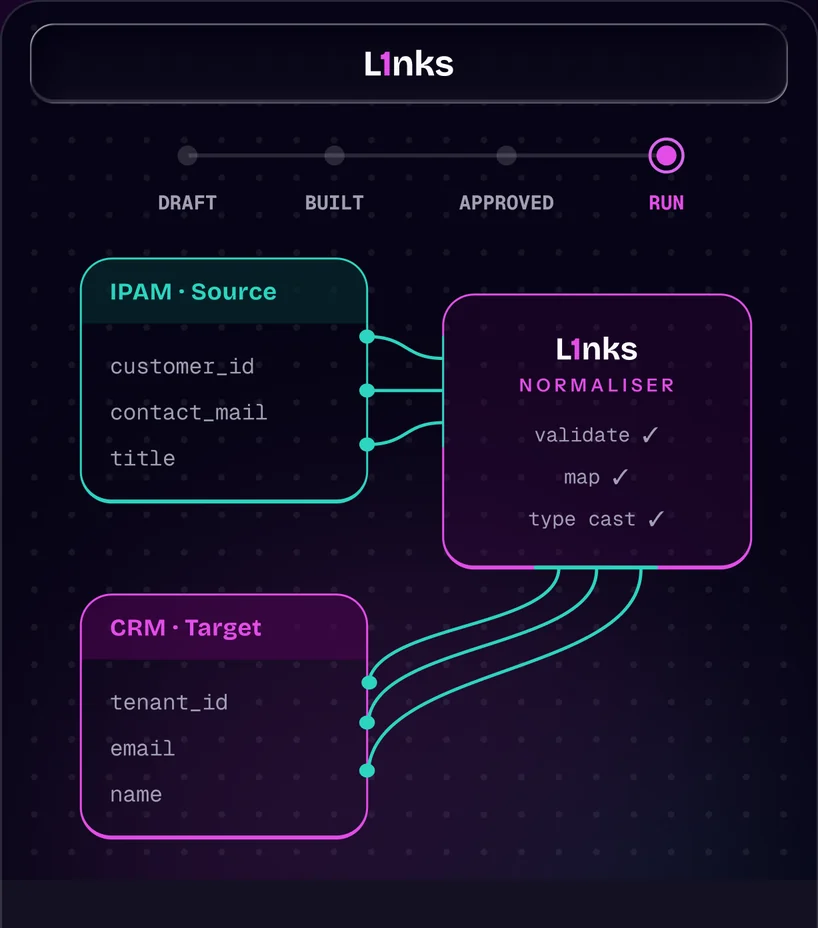
The catalogue records the contents of each system and the names it uses for them. The same record is named differently in each place, customer_id here, tenant_id there, which is why nothing reconciles. The catalogue is what makes mapping possible, because it is the first time every name sits in one list.
Validate
Validation and mapping while data moves
Validation, mapping and type casting happen in transit, so what arrives is already correct and the receiving system is spared the reconciliation that normally follows. A record leaves one system as customer_id, contact_mail and title and lands in the next as tenant_id, email and name, validated, mapped and cast on the way. The data is right before any workflow touches it.
Data orchestration
Live flows between systems that never matched
Going live means switching a flow on from the canvas, and your own team does it. Flows run on demand or on a schedule, whichever the work needs. When a vendor changes an API version, the change is absorbed at that system’s single connection, and every flow through it keeps running.
How it works
The L1nks intelligence loop
This is how the platform runs once it is live, not how it is implemented. Seven stages in a cycle that closes rather than ends: a new system or a changed schema re-enters at Discover instead of starting a fresh project. Your team decides at each turn, the platform does the rest.
-
Discover
Auto catalogue all data sources. The platform finds systems and fields, your team confirms what is in scope.
-
Connect
Link structured and unstructured data. Each system connects once, your team approves the credentials and the roles.
-
Govern
Automate compliance and access. Role based access is switched on, and your team sets who may see what.
-
Orchestrate
Manage data flows. Flows run on demand or on a schedule, and your team changes them on the canvas without a developer.
-
Automate
The platform learns from each flow and improves the next mapping it proposes. Your team accepts or corrects.
-
Deliver
Unified access for analytics and AI. Reports and AI read one version of each record.
-
Learn
Feed insights back into the loop. A schema change or a new system re-enters at Discover, not as a new project.
The problem it solves
How L1nks solves the integration sprawl problem
Point to point integration creates duplicate effort across every connection, higher engineering cost, and slower delivery with fragile change management. L1nks replaces the mesh with a hub.
- Every system connects once, to the fabric, and never to another system.
- A new system adds one connection, not one per existing system, so cost grows in a line rather than a curve.
- Records are validated and mapped in transit, so reconciliation work disappears from the receiving systems.
- A vendor’s version change is absorbed at one connection and every flow through it keeps running.
- Your team changes flows on a no code canvas, so the engineering dependency on every data workflow goes.
Deployment
Flexible deployment options
L1nks is platform agnostic. The platform is the same in each deployment, and the choice can change later.
-
On premises servers
Inside your data centre, with hardware supplied through DS Total Solutions if you have none.
-
Private or public cloud
Your own tenancy and keys, or a public region your data rules allow.
-
Hybrid or air gapped
Sensitive data on premises with the rest in the cloud, or a fully offline installation for sensitive clients.
Also from Elev8
Other platforms from Elev8
Private AI connected to your knowledge base, and app experience monitoring from your customers’ perspective.
-
Learn more , Private AI for your business data
Private AI for your business data
For teams that want AI on their own knowledgebase without handing it to a public assistant. Private, per client RAG inside your own network.
-
Learn more , App and network experience
App and network experience
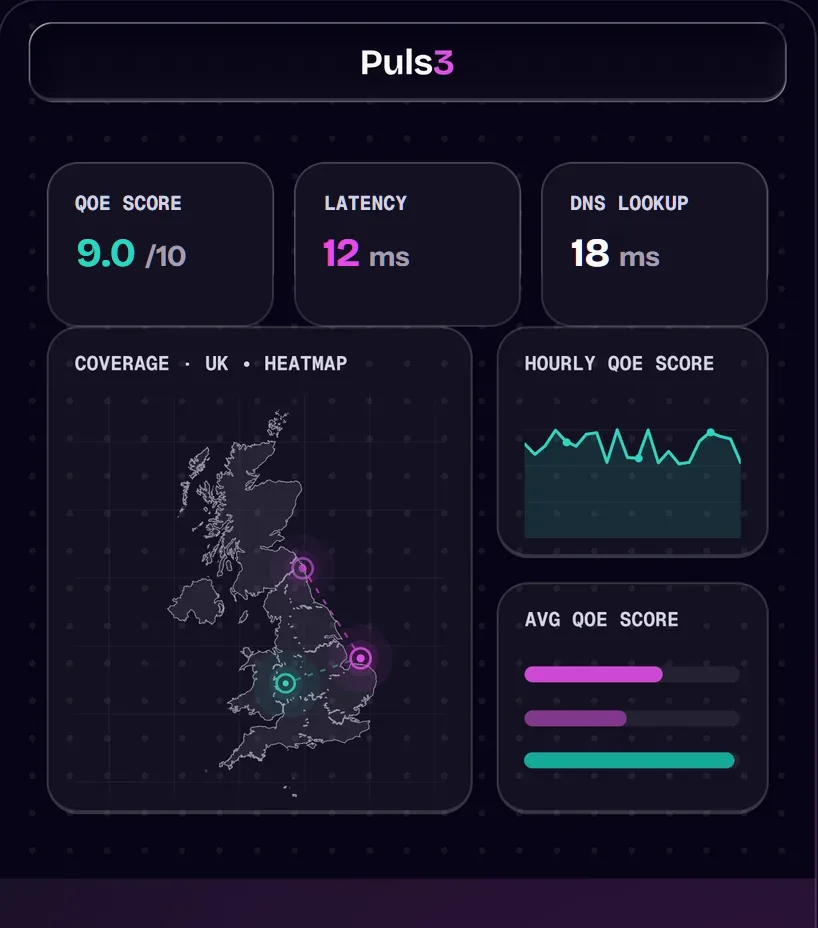
Bots test your network from the customer's end, on a schedule or on demand, so you can identify service issues before a customer complains.
Insights from our team
Notes on data that disagrees with itself and what to connect first.
-
Data governance that survives an audit
What data is held, what for, and who governs it, written down in a form a regulator will accept.
-
AI strategy for regulated industries
Where AI is worth using in a regulated business, where it is not, and how to tell the difference before you spend.
-
Retention policies for training data
How long to keep the data a model was trained on, who decides, and how to delete it without losing the audit trail.



Common questions
Questions about L1nks, answered plainly
Everything you need to know about working with Elev8.
Do we need to replace any of the systems we already run?
No. Each system stays the record holder for what it does well and connects once to the fabric. Retiring a system becomes a decision you can take on its own merits later, because the flows around it are already in place.
How does L1nks handle data privacy and security?
Access is granted by role, per system and per field, and revoked when the role ends. Data stays in your estate in whichever deployment you choose, nothing is sent to a third party, and information security is run to ISO 27001 practice.
What deployment options does L1nks have?
L1nks is platform agnostic and supports multiple deployment models: on premises servers, private or public cloud, hybrid environments, or an air gapped installation for sensitive clients. The platform is identical in each and the choice can change later. Where you have no suitable infrastructure, our sister company DS Total Solutions supplies it.
Does data move on demand, or on a schedule?
Either. A flow can run on demand or on a schedule you set, chosen per flow, and it validates and maps records on the way whichever way it runs. A receiving system that needs batches gets them, and one that needs a record as soon as it is asked for gets that.
How is L1nks priced?
Per deployment, on the number of connected systems rather than on data volume. Implementation is scoped from an audit of your systems and priced separately. We agree what the licence and support cover with you.
See L1nks running on your systems
Tell us which systems disagree with each other, and we will be in touch to arrange a demo.