


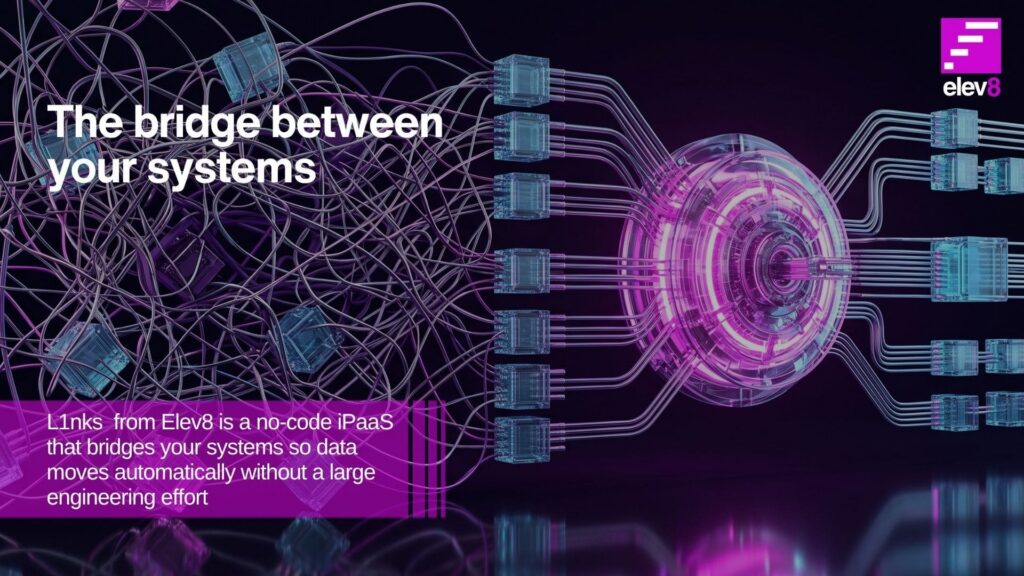
A cloud platform that connects applications and data and APIs into one system is known as iPaaS. The full term is integration platform as a service (iPaaS). This platform lets an organisation join its tools without building each connection by hand. Most companies now run many separate systems that are due to the fact that they were never designed to share any data.
Companies ran an average of 106 SaaS applications in 2024 which is according to BetterCloud. The iPaaS market reached an estimated $15.6 billion in 2025 according to Fortune Business Insights.
iPaaS Working System
The iPaaS operates as a bridge between systems in an organisation to transfer data.
The platform comes with prebuilt connectors, meaning that each link does not require coding. It maps fields between systems so the data arrives in a usable form (data mapping). The platform then schedules and runs these flows and watches them for failures (orchestration). Most of this work happens through a visual interface rather than through custom development.
The different ways iPaaS is used
An iPaaS is used to connect cloud applications and on-premises systems into a single flow. A common use is to keep customer records in step across a CRM and a finance system.
Another use moves data into a central store so reporting draws on one source. Many teams rely on the platform to automate routine processes that span several systems. Identity resolution is a frequent task because one customer often appears in several records.
How to benefit from iPaaS
The main benefit of an iPaaS is faster integration without a large engineering effort. Point-to-point integration instead requires a separate build for every pair of connected systems. That approach grows complex quickly because each new system multiplies the links required. An iPaaS reduces the work because every connection runs through
one managed platform. Governance also improves because the integration flows are visible and centrally controlled.
iPaaS and APIs
An API is a way for one system to request data or actions from another. An iPaaS uses APIs and adds the connectors and mapping and orchestration around them. The API provides the access point and an iPaaS manages many such access points together. A team can call APIs directly although the volume of connections soon needs a platform.
Which iPaaS to choose
The right iPaaS depends on company size and budget and the systems that need connecting. Heavy enterprise platforms suit large estates while lighter tools suit smaller technical teams. A fuller comparison of the main options sets out the trade-offs by company size. L1nks from Elev8 is one no-code option built for the middle of that range.
Frequently asked questions
What is an iPaaS?
An iPaaS is a cloud platform that connects applications and data and APIs into one system. The platform lets an organisation integrate its tools without coding each connection by hand.
What is it used for?
An iPaaS connects cloud and on-premises systems so data moves between them automatically. Common tasks include syncing records and centralising data and automating processes that span systems.
What is the difference between iPaaS and an API?
No, an API is one point of access between two systems, an iPaaS manages multiple. An iPaaS is an API architecture that provides connectors and mapping/orchestration.
What is an example?
Business platforms can vary from a complex enterprise solution to a simple automation tool in the market. L1nks from Elev8 is a no-code option and the right choice depends on company size and budget.